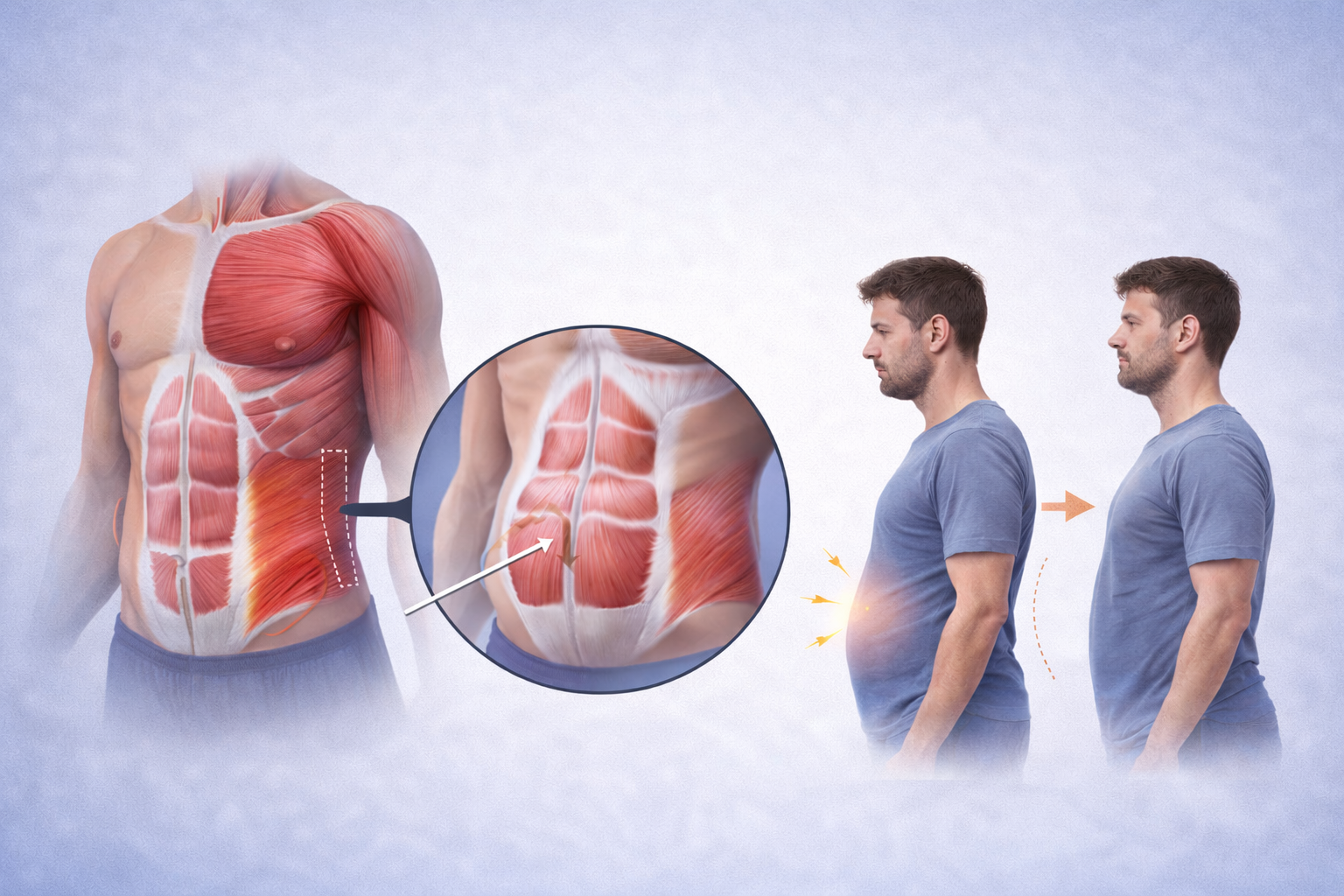
Chronic back pain and poor posture often stem from a neurological breakdown of the deep core system most notably the TVA muscle.
Many people spend years chasing relief from back pain, struggling to improve their posture, or trying endlessly to “flatten their belly” yet the real problem often remains untouched.
The missing link is not weak abs.
It’s not a lack of crunches.
And it’s not just poor posture habits.
It’s a failure of the deep core control system, with the Transverse Abdominis (TVA) at the center.
When the TVA isn’t functioning properly, the body loses its internal support system — leading to spinal instability, compensatory muscle tension, postural collapse, and abdominal protrusion that no amount of sit-ups will fix.
What Is the TVA and Why It’s Different From “Abs”
The Transverse Abdominis (TVA) is the deepest abdominal muscle.
Unlike the superficial six-pack muscles that create movement, the TVA’s primary job is stability.
Think of it as:
- A corset around the spine and organs
- A pressure regulator inside the abdomen
- A stability coordinator, not a mover
When it activates correctly, it gently draws the abdominal wall inward, increases intra-abdominal pressure, and stabilizes the spine before movement occurs.
This anticipatory stabilization is critical — and it’s exactly what’s missing in many people with chronic pain or poor posture.
The Deep Core: A Coordinated Stability System (Not Individual Muscles)
Modern research and developmental kinesiology show that the TVA does not work alone.
It functions as part of an integrated deep core system, which includes:
- The TVA
- The internal and external obliques
- The diaphragm
- The pelvic floor
- Deep spinal stabilizers (multifidi)
Together, these muscles form a 360-degree pressure system that stabilizes the spine, pelvis, and ribcage during every movement — from breathing and walking to lifting and reaching.
This system is the foundation of postural stability.
When it’s working properly:
- The spine feels supported without stiffness
- Posture becomes effortless
- The belly naturally flattens
- Movement feels smooth and coordinated
When it fails:
- Superficial muscles take over
- The body braces instead of stabilizing
- Pain and compensation patterns emerge
Why Traditional Fitness Fails to Train the TVA Properly
Mostexercise programs unintentionally bypass or inhibit the deep core system.
Common mistakes include:
- Overemphasizing crunches, planks, and sit-ups
- Training “core strength” without breath control
- Bracing instead of coordinating
- Isolating muscles instead of restoring patterns
These approaches often strengthen the outer core while leaving the deep stabilizers neurologically offline.
As a result, people may get stronger — but not more stable.
Why the TVA System Becomes Dysfunctional in the First Place
TVA dysfunction is extremely common, and it rarely happens for just one reason.
1. Prolonged Sitting
Sitting places the spine in flexion, reduces diaphragmatic excursion, and shuts down deep stabilizers. Over time, the brain stops using the TVA as a primary stabilizer.
2. Incorrect Training
Heavy lifting, excessive bracing, or “sucking in” the stomach can reinforce compensatory strategies that override true deep core coordination.
3. Poor Breathing Mechanics
Shallow chest breathing disconnects the diaphragm from the TVA and pelvic floor — breaking the pressure system that stabilizes the spine.
4. Genetic & Structural Predispositions
Some individuals are naturally more lax, more rigid, or asymmetrical, making them more vulnerable to deep core instability.
5. Aging & Sedentary Lifestyle
As movement variety decreases with age, the nervous system defaults to simpler, less efficient stabilization strategies.
The key point:
This is not a strength problem — it’s a control problem.
How our MAPS™ Protocol Restores the TVA and Deep Core System
At Body in Balance Chiropractic, we don’t try to “strengthen” the TVA in isolation.
We restore its neurological role inside the entire movement system using our MAPS™ approach:
Movement
Alignment
Posture
Stability
Alignment Comes First
Precise chiropractic care restores joint positioning and sensory input to the nervous system. Without proper alignment, the brain cannot accurately activate stabilizing muscles.
Neurological Movement Re-Patterning
Our exercise protocol is designed to:
- Reconnect breath to movement
- Restore timing between the diaphragm, TVA, and pelvic floor
- Retrain the brain to stabilize before movement
This is not about doing more reps — it’s about teaching the nervous system how to organize the body correctly again.
Stability Emerges Naturally
When the TVA system is neurologically restored:
- The spine becomes self-supporting
- Posture improves without conscious effort
- The abdominal wall flattens naturally
- Pain patterns begin to resolve
Movement + Alignment = Postural Stability
Frequently Asked Questions About the TVA and Deep Core Stability
What is the TVA muscle and why is it important?
The transverse abdominis (TVA) is the deepest abdominal muscle and acts as the body’s primary spinal stabilizer. Rather than creating movement, it provides internal support by increasing intra-abdominal pressure and stabilizing the spine before movement occurs. When the TVA functions properly, posture improves, back pain decreases, and the abdominal wall naturally flattens.
How is the TVA different from the “six-pack” muscles?
Unlike the superficial abdominal muscles that create visible definition, the TVA is a deep stabilizing muscle. Its role is neurological and reflexive, meaning it should activate automatically to support the spine. Strengthening the outer abs without restoring TVA coordination often leads to stiffness, compensation, and persistent pain.
What muscles work together with the TVA as the deep core?
The TVA functions as part of an integrated deep core system that includes the diaphragm, pelvic floor, obliques, and deep spinal stabilizers. Together, these muscles create a 360-degree pressure system that supports posture, balance, and spinal stability. This system must work in coordination, not isolation.
Why doesn’t traditional core training activate the TVA properly?
Most fitness programs focus on strengthening surface muscles through exercises like crunches and planks. These movements often bypass the neurological control system that governs deep stability. Without proper breath coordination and timing, the TVA remains underactive even in people who are physically strong.
Can a weak or dysfunctional TVA cause back pain?
Yes. When the TVA fails to stabilize the spine, the body compensates by overusing superficial muscles. This leads to increased spinal load, joint stress, and muscle tension—common contributors to chronic back pain, disc issues, and postural fatigue.
Why does the belly protrude even in people who exercise?
A protruding belly is often a sign of deep core dysfunction rather than excess body fat. When the TVA is not functioning properly, the abdominal wall loses its natural tension and support. No amount of sit-ups can correct this without restoring proper neurological activation.
What causes the TVA to become dysfunctional?
TVA dysfunction commonly develops due to prolonged sitting, shallow breathing, incorrect exercise strategies, genetic predispositions, aging, and sedentary lifestyles. Over time, the nervous system forgets how to coordinate deep stabilizing muscles efficiently.
How does the MAPS™ approach restore TVA function?
MAPS™ focuses on restoring alignment, retraining movement patterns, and re-educating the nervous system. Rather than strengthening the TVA directly, our exercise protocol teaches the brain how to activate the entire deep core system automatically, leading to lasting postural stability and pain relief.
How long does it take to retrain the TVA and deep core system?
Because TVA dysfunction is neurological, improvement depends on consistent retraining rather than forceful strengthening. Many patients begin to notice improved posture, stability, and reduced pain within weeks, with more lasting changes developing over several months.
Is TVA retraining helpful for posture and aging?
Absolutely. As we age, the nervous system becomes less efficient at stabilizing the body. Retraining the deep core system helps maintain upright posture, balance, and movement efficiency—reducing strain on joints and decreasing the risk of chronic pain.
The Takeaway
If you’ve tried strengthening your core but still struggle with:
- Back pain
- Hip pain
- Disc problems
- Sciatica
- Poor posture
- A protruding belly
- A feeling of instability
You’re not missing effort — you’re missing neurological coordination.
The TVA is not meant to be forced.
It’s meant to be re-educated.
That’s the difference between exercise and transformation — and it’s exactly what MAPS™ is designed to do.
If you’re ready to restore your deep core system and build lasting stability from the inside out, schedule a consultation to see how the MAPS™ approach can help you move, stand, and live better — without chasing symptoms.
About the Author:
Dr. Jan Lefkowitz, DC, is a chiropractor and founder of Body in Balance Chiropractic located in New York City as well as Westchester. He is the creator of the MAPS™ (Movement, Alignment, Posture, Stability) approach, a neurological system designed to restore postural stability, improve movement efficiency, and resolve chronic pain by retraining the brain–body connection. Dr. Lefkowitz specializes in complex posture dysfunction, chronic pain, spinal instability, and integrative, movement-based care.